Showing posts with label Japan. Show all posts
Showing posts with label Japan. Show all posts
Fish still swimming after cutting part of flesh
A sushi chef in Japan cut half of a fish into sashimi dishes and the fish is still alive and swimming.

Japan’s Crystal Brick House
Architects are often societal renegades with their own private visions and concepts of design. Close your eyes and picture rugged individualist Gary Cooper in the classic film The Fountainhead that was popular in the last century. After all, architecture is a statement of human progress, achievement and technology.
In keeping with usual visions and perspectives, consider this magnificent Japanese crystal brick structure that comes as close as any building can be to a custom-made, magical design that aims to please those who are paying for it.

Japanese architect, Yasuhiro Yamashita (Atelier Tekuto) aims to please his clients and loves the challenge of working with diverse people, materials and environments. This house was constructed with the idea that it would be as sunny and bright as the many crystals the client amassed as a hobby.
The glass blocks comprise the primary structure, which in itself is positively amazing. The actualization of this novel concept was the end result of collaboration with structural engineers, university experiments, construction companies and diverse manufacturing interests.
His thinking revolves around the concept of masonry; that is, architecture that stifles individuality and achieves totality by stacking identical objects on top of each other on the proposed structure. Glass block is not one of the more common elements used in masonry. More popular materials include: marble, granite, travertine, limestone, concrete block and tile.

Yamashita’s architecture conveys three concepts: society, the environment and function. In an effort to do his part in reducing the carbon footprint, he has become increasingly reliant on natural resources such as wood, soil and brick.
“I …create my architecture based on the system of society, the environment, the function, and the collaboration with people from various fields. … I now also focus on the relationship with other countries and regions. Recently I increasingly care for the environment by using natural resources… I continue to create new visions of architecture in different circumstances and places for the future”, says Yamashita.
In keeping with usual visions and perspectives, consider this magnificent Japanese crystal brick structure that comes as close as any building can be to a custom-made, magical design that aims to please those who are paying for it.

Japanese architect, Yasuhiro Yamashita (Atelier Tekuto) aims to please his clients and loves the challenge of working with diverse people, materials and environments. This house was constructed with the idea that it would be as sunny and bright as the many crystals the client amassed as a hobby.
The glass blocks comprise the primary structure, which in itself is positively amazing. The actualization of this novel concept was the end result of collaboration with structural engineers, university experiments, construction companies and diverse manufacturing interests.
His thinking revolves around the concept of masonry; that is, architecture that stifles individuality and achieves totality by stacking identical objects on top of each other on the proposed structure. Glass block is not one of the more common elements used in masonry. More popular materials include: marble, granite, travertine, limestone, concrete block and tile.

Yamashita’s architecture conveys three concepts: society, the environment and function. In an effort to do his part in reducing the carbon footprint, he has become increasingly reliant on natural resources such as wood, soil and brick.
“I …create my architecture based on the system of society, the environment, the function, and the collaboration with people from various fields. … I now also focus on the relationship with other countries and regions. Recently I increasingly care for the environment by using natural resources… I continue to create new visions of architecture in different circumstances and places for the future”, says Yamashita.
"Baby-Cry Sumo" Competition

Sumo wrestling students hold babies as they try to make them cry during the Crying Sumo competition at Sensoji Temple on April 25, 2010 in Tokyo, Japan. The first baby to cry wins the competition. The ceremony takes place in Japan to wish for the good health of the child as it is said that crying is good for the health of babies.
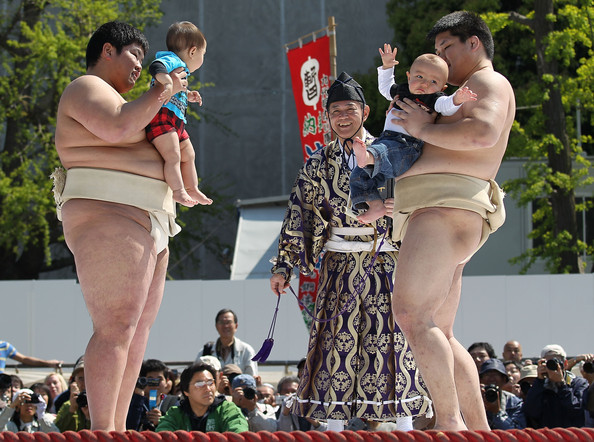


Colorful carp streamers are are waving in the spring wind during the Crying Sumo competition at Sensoji Temple on April 25, 2010 in Tokyo, Japan. The first baby to cry wins the competition. The ceremony takes place in Japan to wish for the good health of the child as it is said that crying is good for the health of babies.
6 Strange Asian Beverages
Sodas and other beverages made for the Japanese market can often seem strange to us in the Western world. But what may seem like an odd flavor to us is often very popular in Japan.
From curry-laced soda to “cheese drink”, here are some strange Japanese beverages you may not have heard of.
1. Curry and Wasabi Ramune

Ramune is a popular Japanese soda that is usually fruit flavored, and is recognized by its unique bottle shape and glass bead stopper. However, Ramune also makes two strongly flavored sodas: Curry and Wasabi.
The label on the curry flavored Ramune explains that it is actually a combination of curry and lemonade flavors.
2. Pepsi White/Yogurt Pepsi

This limited edition version of Pepsi blended the sweet taste of cola with the creaminess and tartness of yogurt.
3. Fanta Furufuru Shaker

This beverage starts off in a semi-gelled state, but when you shake it, the Fanta becomes carbonated. Seems like shaking a carbonated beverage never ends well, though…
4. NEEDS Cheese Drink

Because Japan is an island nation, it has been historically hard to support a large dairy industry because of the limited amount of available land. Therefore, many Japanese people have never developed much of a taste for milk products. Today, however, some companies are hoping to introduce more dairy into the Japanese marketplace. One such attempt is NEEDS cheese drink, which reportedly tastes a bit like yogurt.
5. Coolpis Kimchi

Fermented cabbage? Hot peppers? Sounds like a refreshing drink to me!
6. Breast Enlarging Drink

Okkikunare brand drinks contain a soy additive that the company claims can increase breast size. “Okkikunare” literally means “make them bigger!”
Pictured above are the mango and peach flavors.
From curry-laced soda to “cheese drink”, here are some strange Japanese beverages you may not have heard of.
1. Curry and Wasabi Ramune

Ramune is a popular Japanese soda that is usually fruit flavored, and is recognized by its unique bottle shape and glass bead stopper. However, Ramune also makes two strongly flavored sodas: Curry and Wasabi.
The label on the curry flavored Ramune explains that it is actually a combination of curry and lemonade flavors.
2. Pepsi White/Yogurt Pepsi

This limited edition version of Pepsi blended the sweet taste of cola with the creaminess and tartness of yogurt.
3. Fanta Furufuru Shaker

This beverage starts off in a semi-gelled state, but when you shake it, the Fanta becomes carbonated. Seems like shaking a carbonated beverage never ends well, though…
4. NEEDS Cheese Drink

Because Japan is an island nation, it has been historically hard to support a large dairy industry because of the limited amount of available land. Therefore, many Japanese people have never developed much of a taste for milk products. Today, however, some companies are hoping to introduce more dairy into the Japanese marketplace. One such attempt is NEEDS cheese drink, which reportedly tastes a bit like yogurt.
5. Coolpis Kimchi

Fermented cabbage? Hot peppers? Sounds like a refreshing drink to me!
6. Breast Enlarging Drink

Okkikunare brand drinks contain a soy additive that the company claims can increase breast size. “Okkikunare” literally means “make them bigger!”
Pictured above are the mango and peach flavors.
Monster Jellyfish Take Aim at Japan
The gigantic creature can wreak havoc on fishing nets and their contents, destroying the nets and poisoning the catch. Even nuclear powerplants aren’t safe: Reports describe the jellyfish being sucked into pumps that draw seawater to cool the reactors.

What’s 6 feet wide, weighs 440 pounds, and can ruin your whole day? If you’re a Japanese fisherman, the answer is Nomura’s jellyfish (Nemopilema nomurai), or, as the Japanese call it, echizen kurage.
Echizen kurage have shown up in Japanese waters in increasing numbers in recent years. The population surge of 2005 was particularly bad, affecting the salmon, yellowtail, and anchovy fisheries. But the mass of them gathering now in the Yellow Sea off China is the biggest ever, and eventually ocean currents will deliver them to Japan’s doorstep.
The reasons for the exploding population are not clear. Theories range from agriculture runoff to overfishing to global warming. As for fighting the jellyfish, methods are few and far between. In fact, when under attack, the creatures release millions of sperm or eggs, all with the potential to grow more jellyfish.
There have been efforts to make the most of this plague by creating jellyfish products. Some of them are edible, including ice cream and even cookies. Echizen kurage is also a source of collagen, which can be used in cosmetics.
But the jellyfish invasion in store for Japan this time around is likely to deliver more raw materials than any such efforts could possibly keep up with. The result could be devastation for much of Japan’s fishing industry.
Credits By weirdasianews.com

What’s 6 feet wide, weighs 440 pounds, and can ruin your whole day? If you’re a Japanese fisherman, the answer is Nomura’s jellyfish (Nemopilema nomurai), or, as the Japanese call it, echizen kurage.
Echizen kurage have shown up in Japanese waters in increasing numbers in recent years. The population surge of 2005 was particularly bad, affecting the salmon, yellowtail, and anchovy fisheries. But the mass of them gathering now in the Yellow Sea off China is the biggest ever, and eventually ocean currents will deliver them to Japan’s doorstep.
The reasons for the exploding population are not clear. Theories range from agriculture runoff to overfishing to global warming. As for fighting the jellyfish, methods are few and far between. In fact, when under attack, the creatures release millions of sperm or eggs, all with the potential to grow more jellyfish.
There have been efforts to make the most of this plague by creating jellyfish products. Some of them are edible, including ice cream and even cookies. Echizen kurage is also a source of collagen, which can be used in cosmetics.
But the jellyfish invasion in store for Japan this time around is likely to deliver more raw materials than any such efforts could possibly keep up with. The result could be devastation for much of Japan’s fishing industry.
Credits By weirdasianews.com
Capsule Hotels?
Sometimes what happens in Japan stays in Japan, and the “capsule hotel” phenomenon is a prime example. Unlike, say, sushi or the Honda Civic, this is one Japanese invention that hasn’t triggered a stampede of foreign adopters and imitators.

Sometimes what happens in Japan stays in Japan, and the “capsule hotel” phenomenon is a prime example. Unlike, say, sushi or the Honda Civic, this is one Japanese invention that hasn’t triggered a stampede of foreign adopters and imitators.
In case you’re wondering, it’s not as if you’re expected to wedge yourself into your snug plastic enclosure and stay there the whole time. Capsule hotels typically feature common areas such as a lounge and bathing/toilet facilities as well as those sleeping pods.

And to be fair, it should be pointed out that the Thermos-style enclosures have amenities the average coffin lacks, such as TV and radio. In fact, maybe “coffin” is too harsh a word—“kennel” might be better. Most importantly, capsule hotels are substantially cheaper than standard hotels. As long as you’re not claustrophobic, that idea is sure to appeal.
The Capsule Inn Akihabara is a high-rise honeycomb of sleeping pods in one of Tokyo’s most wired-up, hyperactive neighborhoods. For a rock-bottom 4,000 yen, they’ll provide you with one of 169 pods (140 for men, 29 for women), each measuring a whopping 1 x 1 x 2 meters. If you can manage to extricate yourself after your night’s sleep without calling the fire department, you’ll find yourself right in the middle of the action.
Credits by weirsasianews.com

Sometimes what happens in Japan stays in Japan, and the “capsule hotel” phenomenon is a prime example. Unlike, say, sushi or the Honda Civic, this is one Japanese invention that hasn’t triggered a stampede of foreign adopters and imitators.
In case you’re wondering, it’s not as if you’re expected to wedge yourself into your snug plastic enclosure and stay there the whole time. Capsule hotels typically feature common areas such as a lounge and bathing/toilet facilities as well as those sleeping pods.

And to be fair, it should be pointed out that the Thermos-style enclosures have amenities the average coffin lacks, such as TV and radio. In fact, maybe “coffin” is too harsh a word—“kennel” might be better. Most importantly, capsule hotels are substantially cheaper than standard hotels. As long as you’re not claustrophobic, that idea is sure to appeal.
The Capsule Inn Akihabara is a high-rise honeycomb of sleeping pods in one of Tokyo’s most wired-up, hyperactive neighborhoods. For a rock-bottom 4,000 yen, they’ll provide you with one of 169 pods (140 for men, 29 for women), each measuring a whopping 1 x 1 x 2 meters. If you can manage to extricate yourself after your night’s sleep without calling the fire department, you’ll find yourself right in the middle of the action.
Credits by weirsasianews.com
Japanese Grape Cluster Sold For 210,000Yen

Fruit is an expensive commodity in Japan and is considered a gift of great luxury. The wealthy consider it a sign of prestige to pay exorbitant prices for high-end fruits, especially the very first ones of the year.
The Ruby Roman is a variety of table grape, which is red in color and about the size of a ping-pong ball. Its one unusual feature appears to be the price it fetches.
A bracelet from Tiffany’s or something of that ilk for the same amount of cold hard cash would certainly last a lot longer than a cluster of grapes, one would think, but then there’s no accounting for taste when “keeping up with the Jones family” takes its own particular hold on one’s thinking.
Local farmers are hoping to sell 1,500 bunches, the equivalent of one ton of grapes by mid-September. Just do the math on that one, if you dare!
A Japanese hotel manager did dare to do the math and paid what comes out to be about $70 dollars per grape for a one-and-one-half pound of Ruby Roman grapes.
He hopes that the publicity surrounding the auction and his purchase will attract even more guests to his upscale hotel. Can you imagine what he will charge them for just a taste of one of these? (And he better hurry. No one likes sour grapes at any cost!)
“We believe the price was probably a record high. They’re delicious, sweet but fresh at the same time, very well balanced,” said local agricultural official, Hirofumi Isu.
The Ruby Roman is a variety of table grape, which is red in color and about the size of a ping-pong ball. Its one unusual feature appears to be the price it fetches.
A bracelet from Tiffany’s or something of that ilk for the same amount of cold hard cash would certainly last a lot longer than a cluster of grapes, one would think, but then there’s no accounting for taste when “keeping up with the Jones family” takes its own particular hold on one’s thinking.
Local farmers are hoping to sell 1,500 bunches, the equivalent of one ton of grapes by mid-September. Just do the math on that one, if you dare!
A Japanese hotel manager did dare to do the math and paid what comes out to be about $70 dollars per grape for a one-and-one-half pound of Ruby Roman grapes.
He hopes that the publicity surrounding the auction and his purchase will attract even more guests to his upscale hotel. Can you imagine what he will charge them for just a taste of one of these? (And he better hurry. No one likes sour grapes at any cost!)
“We believe the price was probably a record high. They’re delicious, sweet but fresh at the same time, very well balanced,” said local agricultural official, Hirofumi Isu.
Credits by weirdasianews.com
Japanese Kanji Shirts
Kanji, a Japanese written language, have always been extremely popular. People use them in art, as decoration in their homes, as tattoos on their bodies, and even in clothing fashion.
1.Beware of Pervent


Men touching women in trains is a real problem in Japanese urban life, and there are actually signs in some places warning women to “beware of perverts.” Here’s a great T-shirt that captures this zaniness, featuring a bizarre image of a man toughing a woman on a train and a message of “Beware of Perverts” (Chikan chuui), with “Dangerous Persons are in this Area” printed below. A truly bizarre message and image that will cause confusion and funny reactions among Japanese who see it.
2.“Sake-bito” (I Love Alcohol)


A parody of famous shima-bito (Island-Person) designs from Okinawa, this shirt proudly proclaims you as a sake-bito, literally a “person of sake” or someone who loves to drink all forms of alcohol. (Sake, pronounced sah-KAY, can refer to normal rice wine as well as all other forms of alcohol).
3.“Caution: Karoshi” (Death from Overwork)


Caution: Karoshi. Japanese are very industrious and hardworking — in fact they can work so hard that there’s a word for “death from overwork” (karoshi). Here’s a wacky Japanese T-shirt that warns you not to work too hard, to take time to smell the roses as you travel down the road of life. The message on the shirt says “Karoshi: be careful not to work too hard.”
4.“No Normal Humans” ~ Haruhi Parody


The character Haruhi from the Melancholy of Haruhi Suzumiya has become one of the most popular ever. A girl who is bored with school and who has no interest in ordinary humans, she seeks to meet aliens, time travelers, sliders or espers, and yet these people are going to school right alongside her without her noticing. If you love Haruhi, here’s a great T-shirt design for you that says “Not Interested in Normal Humans,” inviting all those who are a little “different” to join their club.
5.“Ecchi” (Ecko Parody)


In Japanese, the letter “H” (pronounced “ecchi”) is a euphemism for anything sexual, and someone who is “ecchi!” thinks about sex a little too much. Here’s a great T-shirt design which parodies the famous Ecko Unlimited rhinoceroses with a fun perverted new version.
6.“It is Forbidden to Urinate Here"


For whatever reason, Japanese men think nothing of stopping to urinate outdoors wherever they might be, along the side of the road or into a rice field, even while passing a beautiful Buddhist Temple. Here’s a cool shirt that says “It is forbidden to urinate here,” that’s modeled after real signs you can see in Japan.
7.“Otaku” (Oakley parody)


The word “otaku” has come to describe anyone who loves manga, anime and Japanese popular culture, although anyone with passion can become an “otaku” about something they love. This T-shirt parodies the famous Oakley logo by changing it into a message that fans can appreciate.
8.“In Case of Emergency, Commit Seppuku Here"


Ancient samurai were famous for committing ritual suicide by disemboweling themselves with their swords, which was called seppuku or harakiri (two ways to read the same kanji characters). This T-shirt features a wacky message in this tradition, with a Japanese warrior pointing to your midsection and the message, “In case of emergency, cut here.”
9.“Ecchi” (I’m Perverted)


The shirt says “Ecchi” (literally, the letter “H,” which is used in Japan as a euphenism for someone who is perverted or who thinks about sex too much) — you never know what will happen with this shirt on!
10.“Noodle Eater” (Cup Noodle Parody)


Are you a “face eater”? That’s what the word men-kui (men-koo-EE) literally means, and it refers to men who are attracted to extremely beautiful women, especially women with incredibly beautiful faces (men in Japanese). Since the word for “noodles” is also men, it sounds like you’re saying “noodle eater,” hence the joke.
11.“Beware of Panty Thieves"


Throughout history there have been men who have been obsessed with women’s panties, and the Japanese are no different. Here’s a wacky T-shirt featuring a man using a fishing pole to catch a pair of women’s underwear, with “Beware of panty thief” written in kanji below it.
12.“Sukebe” (Pervert)


Sukebe (pronounced “su-KEH-beh”), a word which means someone who thinks about sex just a little too much. Similar to ecchi, a sukebe will never fail to mentally undress a pretty girl while he talks to her.
13.“Beware of Men Peeking”


Japanese men are human, just like everyone else, and sometimes they have trouble controlling their inner urges. Here’s a T-shirt that warns people who see it to beware of “nozoki” — peeping toms, who like to watch women secretly, in the bathroom and elsewhere. The text reads “Beware of Men Peeping” in clear, direct Japanese. Because the word “nozoki” is written with the hiragana writing system, it’s someething that only Japanese can read or understand.
14.“I Like Mixed Bathing"


Many gaijin come to Japan and fall in love with onsen (OWN-sen), the famous natural hot springs that have been enjoyed by Japanese for centuries. The best hot springs are, of course, the mixed-bathing variety, called kon’yoku in Japanese, a special bath where men and women can take a bath together. This T-shirt proclaims your affinity for Japan’s mixed-bathing culture, featuring a kanji slogan that reads “I love mixed-bathing hot springs,” with the normal “heart” shape cleverly replaced by the “onsen mark,” a symbol that denotes Japanese hot springs.
1.Beware of Pervent


Men touching women in trains is a real problem in Japanese urban life, and there are actually signs in some places warning women to “beware of perverts.” Here’s a great T-shirt that captures this zaniness, featuring a bizarre image of a man toughing a woman on a train and a message of “Beware of Perverts” (Chikan chuui), with “Dangerous Persons are in this Area” printed below. A truly bizarre message and image that will cause confusion and funny reactions among Japanese who see it.
2.“Sake-bito” (I Love Alcohol)


A parody of famous shima-bito (Island-Person) designs from Okinawa, this shirt proudly proclaims you as a sake-bito, literally a “person of sake” or someone who loves to drink all forms of alcohol. (Sake, pronounced sah-KAY, can refer to normal rice wine as well as all other forms of alcohol).
3.“Caution: Karoshi” (Death from Overwork)


Caution: Karoshi. Japanese are very industrious and hardworking — in fact they can work so hard that there’s a word for “death from overwork” (karoshi). Here’s a wacky Japanese T-shirt that warns you not to work too hard, to take time to smell the roses as you travel down the road of life. The message on the shirt says “Karoshi: be careful not to work too hard.”
4.“No Normal Humans” ~ Haruhi Parody


The character Haruhi from the Melancholy of Haruhi Suzumiya has become one of the most popular ever. A girl who is bored with school and who has no interest in ordinary humans, she seeks to meet aliens, time travelers, sliders or espers, and yet these people are going to school right alongside her without her noticing. If you love Haruhi, here’s a great T-shirt design for you that says “Not Interested in Normal Humans,” inviting all those who are a little “different” to join their club.
5.“Ecchi” (Ecko Parody)


In Japanese, the letter “H” (pronounced “ecchi”) is a euphemism for anything sexual, and someone who is “ecchi!” thinks about sex a little too much. Here’s a great T-shirt design which parodies the famous Ecko Unlimited rhinoceroses with a fun perverted new version.
6.“It is Forbidden to Urinate Here"


For whatever reason, Japanese men think nothing of stopping to urinate outdoors wherever they might be, along the side of the road or into a rice field, even while passing a beautiful Buddhist Temple. Here’s a cool shirt that says “It is forbidden to urinate here,” that’s modeled after real signs you can see in Japan.
7.“Otaku” (Oakley parody)


The word “otaku” has come to describe anyone who loves manga, anime and Japanese popular culture, although anyone with passion can become an “otaku” about something they love. This T-shirt parodies the famous Oakley logo by changing it into a message that fans can appreciate.
8.“In Case of Emergency, Commit Seppuku Here"


Ancient samurai were famous for committing ritual suicide by disemboweling themselves with their swords, which was called seppuku or harakiri (two ways to read the same kanji characters). This T-shirt features a wacky message in this tradition, with a Japanese warrior pointing to your midsection and the message, “In case of emergency, cut here.”
9.“Ecchi” (I’m Perverted)


The shirt says “Ecchi” (literally, the letter “H,” which is used in Japan as a euphenism for someone who is perverted or who thinks about sex too much) — you never know what will happen with this shirt on!
10.“Noodle Eater” (Cup Noodle Parody)


Are you a “face eater”? That’s what the word men-kui (men-koo-EE) literally means, and it refers to men who are attracted to extremely beautiful women, especially women with incredibly beautiful faces (men in Japanese). Since the word for “noodles” is also men, it sounds like you’re saying “noodle eater,” hence the joke.
11.“Beware of Panty Thieves"


Throughout history there have been men who have been obsessed with women’s panties, and the Japanese are no different. Here’s a wacky T-shirt featuring a man using a fishing pole to catch a pair of women’s underwear, with “Beware of panty thief” written in kanji below it.
12.“Sukebe” (Pervert)


Sukebe (pronounced “su-KEH-beh”), a word which means someone who thinks about sex just a little too much. Similar to ecchi, a sukebe will never fail to mentally undress a pretty girl while he talks to her.
13.“Beware of Men Peeking”


Japanese men are human, just like everyone else, and sometimes they have trouble controlling their inner urges. Here’s a T-shirt that warns people who see it to beware of “nozoki” — peeping toms, who like to watch women secretly, in the bathroom and elsewhere. The text reads “Beware of Men Peeping” in clear, direct Japanese. Because the word “nozoki” is written with the hiragana writing system, it’s someething that only Japanese can read or understand.
14.“I Like Mixed Bathing"


Many gaijin come to Japan and fall in love with onsen (OWN-sen), the famous natural hot springs that have been enjoyed by Japanese for centuries. The best hot springs are, of course, the mixed-bathing variety, called kon’yoku in Japanese, a special bath where men and women can take a bath together. This T-shirt proclaims your affinity for Japan’s mixed-bathing culture, featuring a kanji slogan that reads “I love mixed-bathing hot springs,” with the normal “heart” shape cleverly replaced by the “onsen mark,” a symbol that denotes Japanese hot springs.
Subscribe to:
Posts (Atom)